A new unwanted 'DEVICE' has now appeared suddenly among text on this site, and other blogs. Certain words are highlighted in colour and underlined. If you move the cursor over them, various adverts will appear, from gambling opportunities to Russian women! I have no idea how this unwelcome intrusion has occurred. If YOU know, I would appreciate hearing from you.
......................................................................................................
Today, August 2nd, the device mentioned above has disappeared!
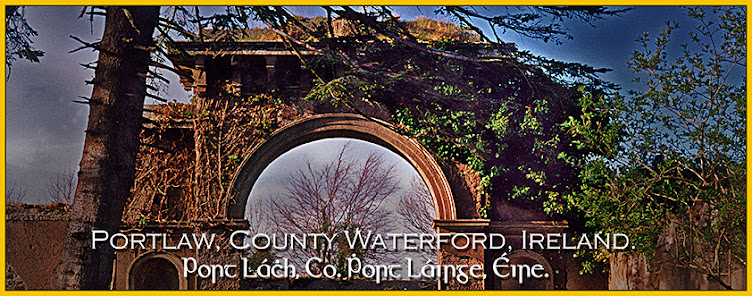
Local places, events and people, also external images since Jan. 2020, illustrated with text, photographs, etc. by site owner. A left click on most images will reveal a larger copy. Text and/or images by the author or other contributors are COPYRIGHT, and may not be reproduced without permission on Internet, or printed publications of any kind. Other sites showing my work: www.flickr.com/photos/mazurka666 www.slieveardagh.com and www.martincentre.info Search name on Fbook
Friday, July 26, 2013


Tuesday, July 23, 2013
"IDLE HANDS . . . "

"Idle hands are the devil's tools", said a bystander as I took this picture. The cones, used to mark a nearby danger spot on the road, taken during the hours of darkness and placed on the still-unfinished fountain. The culprits should realise that these cones were in situ to prevent accidents.
The proverb/phrase attributed to Chaucer from circa 1386, I've been told.
Local barber, Liam, not the culprit, just surveying the scene on July 3rd last.
Friday, June 28, 2013
CURRAGHMORE GATE-LODGES
The Coe family re-union in the previous post, at what is now known as Coes' Lodge in Curraghmore estate, prompts me to show further pictures of the same building and other gate-lodges. To start with, I am showing more pictures of the same building, which is quite photogenic, is located in beautiful surroundings, and looks somewhat different every time one views it. The lodge is located between the Carrick Gate lodge and Farm Lodge.
Speaking to a German biblical scholar back in 2000 approx., who lived for some time at Tower Hill cottages, which overlook Coes' Lodge, when he invited me up to tea one evening, I remarked that it was quite a lonesome place to live, and that he didn't even have TV for entertainment. His response . . . 'That's my TV screen out there (looking out towards the lodge and the Comeragh mountains), and the picture is changing every minute!. What more could a man want?' How true his remark was . . . a different 'look' to the scene almost every minute, due to the changing light, and then the different look during the changing seasons. The building in question also presents a different image every few metres from the Clonagam road due to the changing position of trees, walls, animals, etc.


The above image, taken on a winter's day in 2010, is my favourite, the sheep, the colour of the grass, and the bare trees, making it somewhat memorable. The fine double tree to the right of the lodge here, fell down just about a week prior to the family reunion, and has since been sawn and carted away!


Same lodge, towards mountains, from the polo field.

A February day in 2012.

The lodge at what is called Kellys' Gate, taken in July of this year.

The lodge as seen in June of this year with current tenant, Mr Stephen Delaney, working in the adjoining garden.

Same premises in the snow of January 2010.
Speaking to a German biblical scholar back in 2000 approx., who lived for some time at Tower Hill cottages, which overlook Coes' Lodge, when he invited me up to tea one evening, I remarked that it was quite a lonesome place to live, and that he didn't even have TV for entertainment. His response . . . 'That's my TV screen out there (looking out towards the lodge and the Comeragh mountains), and the picture is changing every minute!. What more could a man want?' How true his remark was . . . a different 'look' to the scene almost every minute, due to the changing light, and then the different look during the changing seasons. The building in question also presents a different image every few metres from the Clonagam road due to the changing position of trees, walls, animals, etc.

The above picture was taken less than twenty-four hours after that shown in the Coe Family Reunion article!


The above image, taken on a winter's day in 2010, is my favourite, the sheep, the colour of the grass, and the bare trees, making it somewhat memorable. The fine double tree to the right of the lodge here, fell down just about a week prior to the family reunion, and has since been sawn and carted away!

This was the scene two days after image No. 558!


Located beside this attractive oak tree, the above gate-lodge has been the dwelling-place of individuals or families who looked after the estate entrance on the road to Carrick-on-Suir for many generations.
 The same lodge looking SW on a November day

with slight frost showing on the mountain top.

Same lodge, towards mountains, from the polo field.

A February day in 2012.

The lodge at what is called Kellys' Gate, taken in July of this year.

The lodge as seen in June of this year with current tenant, Mr Stephen Delaney, working in the adjoining garden.

Same premises in the snow of January 2010.
Further images to follow in this section.
Monday, June 24, 2013
COE FAMILY REUNION - June 12th, 2013.

A unique and
rainy family reunion took place recently at a now-defunct gate-lodge on Curraghmore
estate, Portlaw, when distant relatives from California and Washington state,
USA, in addition to members of the
Portlaw Coe family, visited Coes’ Lodge , Curraghmore house and garden, and
numerous other places throughout the county. The entire group, over a five day
period, also visited Guilcagh cemetery
to pay their respects at the Coe family grave there, also Coe relations at
Fenagh, County Carlow.
Pictured
here, left to right, are: back row – Brian Lavis, Margaret Coe, Mary Coe, Anne Coe (wife of Liam Coe), young Caroline
Vo (partly concealed), Amy Coe, David Coe and Liam Coe; front row – Rosanne Coe, Emma Coe,
Christopher Lavis, Anne Coe (daughter of Mary Coe)), Wendy Lavis (wife of Brian Lavis), Brenda Lavis-Vo, and
her husband – Jack Vo. Missing from the
picture are Richard, Sarah and Thomas Coe – other children of Liam Coe.
The picture,
held by members of the group, shows the
late Frances Coe, who emigrated from the gate-lodge in the background, to
Cardiff in 1943, and married Welshman,
Christopher Lavis (under the blue umbrella), now aged 89, and now making this nostalgic visit with some
members of his family. Christopher and Frances later emigrated to California,
and in more recent times to Seattle, Washington state. The late Frances Coe was a first cousin of
the late Dick Coe (husband of Mary) of Brown Street, a prominent member of the
Church of Ireland in Portlaw, and for many years a member of the Select Vestry.
Mary Coe is a member of the Brennan
family from Main St., Mooncoin. The Portlaw Coes were descendants of Coes
from Wexford, and Tennants from Fenagh, Co. Carlow.
Thanks to John Brennan, brother of Mary Coe, for protecting me and my camera from the rain while taking a series of pictures at this venue!
............................................................................................................................
A single left click on the image will show a larger version on a black background.
Thanks to John Brennan, brother of Mary Coe, for protecting me and my camera from the rain while taking a series of pictures at this venue!
............................................................................................................................
A single left click on the image will show a larger version on a black background.
Friday, May 10, 2013
The ROSENALLIS CONNECTION

Twice in the past 35 years I have briefly visited the Quaker
cemetery at Rosenallis, County Laois (formerly called Queen’s County), while enjoying the picturesque and historic Sliabh
Bloom mountains area. However, there never was time to to take some photos of
the place. On this visit, in May 2013, I was determined to stay a little longer
at this place, which has important Quaker links, as I remembered that it seemed
to have Portlaw , or certainly Waterford city connections. However, my
camera was having focusing problems, but the results here are
adequate to convey a reasonable depiction of the scene.
ROSENALLIS, also
known as ROSSINALLIS, is an anglicized
version of the Irish – Ros an
Fhionnghlaise, meaning wooded height of the clear stream.

Inside the main gate was a charming, small, wooded area with some fine trees and a more impressive further entrance gate.

The above sign at this gate, shown above, is quite self-explanatory.

The Quaker movement, also known as the Religious Society of Friends, was founded in England by George Fox in the mid-1600s. He, not yet a Quaker, first came to Ireland circa 1654 to visit some Quaker families in the townland of Tineil/Tinneel/Tinneely, County Laois, location of this particular cemetery.
The grounds are kept in excellent condition, and contain a number of trees, flowering shrubs and heathers. All headstones are of a similar, plain style, and are of a uniform height, except for three approximately on the surrounding wall.

Possibly the most important one is that pictured above, which bears the inscription:
Near this spot is buried
William Edmundson,
the first member of
The Society of Friends,
who settled in Ireland.
Died 31st of the 6th month 1712 (old style)
Aged nearly 85 years.


To the Glory of God
And in memory of
George Pim
Malcomson
And Emilie Maud,
his wife.
The above Pim memorial inscription reads:
John Pim
Of Lackagh &
Rushin, Queen’s Co.,
Son of
William &
Dorothy Pim of
Castle Donington
Leicestershire,
Came to Ireland
1655,
Joined the Society
of Friends 1657.
Died 1718 Aged 77.
His wife Mary
Daughter of William
Pleadwell
Died 1726 Aged 81.
They and about 30
of their
Descendants are
interred
In this burial
ground.

The above useful map,
also a further physical map showing the river valleys and walks in the nearby
Sliabh Bloom mountains, can be found at a junction to the left in Rosenallis
village, as one travels from Mountmellick to Clonaslee. The location of the
Quaker cemetery is shown, in case you missed it as you approached the village.


Ballitore Library & Quaker Museum.
Directly east of
Rosenllis in County Laois, lies the
Quaker village of Ballitore in County Kildare. . Many Quaker families settled
in Ballitore in the 1720s. Although the
first Meeting House there had been erected in 1708, it did not come into use
until the 1730s. Among those early arrivals was Abraham Shackleton, who set up a
boarding school, from which some famous scholars emerged.
One of Ballitore’s best known residents was Mary
Shackleton-Leadbeater, who was born in 1758 to the local schoolmaster, Richard
Shackleton. In her early thirties, she married
a teacher at the school, William Leadbeater, and then some further years later
was made first postmaster in the village. The former post-office now houses the
local library and a small museum devoted to Quaker artefacts, and mementos. The
village and museum are well worth a visit, if you want to learn more about
Quakers (the Society of Friends) in the area.

Mary Leadbeater began writing what later became known as the
Annals of Ballitore in 1766, which
consisted of accounts of local people and happenings, something which she
continued until 1824. She died two years later in 1826. Included in that
writing were her comments on the 1798 United Irishmen Rebellion in the area.
She is still widely spoken of in the area, and a life-size
bronze effigy of her stands behind the Library-cum-Museum. A number of important buildings from that era
are all well signposted. Other villages
in Ireland would do well to likewise flaunt their historical assets. The building is open to visitors from Tuesday to
Saturday, from 12 noon to 5.00 pm, but is closed on Sundays and Mondays.
...................................
In the meantime, I'll be trying to figure out
the relationship between the Portlaw Malcomsons, the Pims, the Bewleys and
maybe even the Waterford city Jacobs of biscuits fame. And, did you know, the first
ever 'Cream Crackers' were produced by Jacobs in Waterford?
N.B. Notice the second 'L' in the Malcomson name on image 551.
ERRORS & OMISSIONS EXCEPTED.
N.B. Notice the second 'L' in the Malcomson name on image 551.
ERRORS & OMISSIONS EXCEPTED.
Subscribe to:
Posts (Atom)